
Knappschaft Kliniken Bottrop GmbH
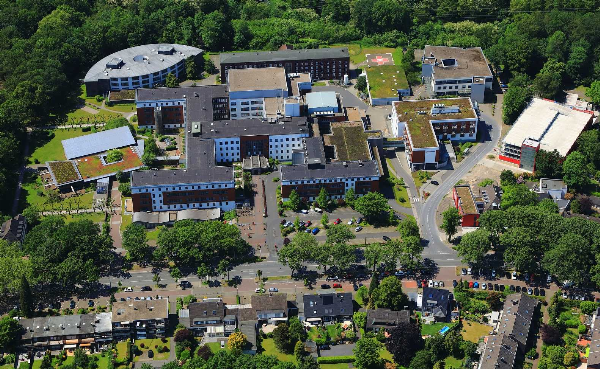
Osterfelder Straße 157
46242 Bottrop
Phone:
02041-15-0
Mail:
ed.nekinilk-tfahcsppank@porttob.tkatnok
kontakt.bottrop@knappschaft-kl...
ed.nekinilk-tfahcsppank@porttob.tkatnok
- Number of beds: 372
- Number of specialist departments: 11
- Number of inpatient cases: 16.946
- Number of partial inpatient cases: 308
- Number of outpatient cases: 71.111
- Hospital owners: Knappschaft Kliniken Bottrop GmbH
- Type of provider: öffentlich
- Academic teaching hospital
- Universität Duisburg-Essen
- Klinik für Anästhesie, Intensivmedizin und Schmerztherapie
- Klinik für Urologie, Kinderurologie und Urologische Onkologie
- Klinik für Innere Medizin V: Altersmedizin
- Klinik für Radiologie, Nuklearmedizin und Neuroradiologie
- Klinik für Allgemein- und Viszeralchirurgie, Unfall- und Wiederherstellungschirurgie - Zentrum für Minimal Invasive Chirurgie
- Klinik für Gefäßchirurgie - vaskuläre und endovaskuläre Chirurgie
- Klinik für Innere Medizin I: Allgemeine Innere Medizin, Gastroenterologie, Hämatologie/Onkologie, Diabetologie
- Klinik für Innere Medizin II: Nephrologie, Rheumatologie, Intensivmedizin
- Klinik für Innere Medizin III: Klinische und interventionelle Angiologie
- Klinik für Innere Medizin IV: Kardiologie
- Klinik für Neurologie
Further information
- External quality assurance according to state law
No participation
Diabetes mellitus Typ 2
| Quantity performed | 1 |
| Exception? | No exception |
| ungeplante OP am Pankreas bei ausgedehnter notfallmäßiger Bauchop | |
| No. | Explanation |
|---|---|
| CQ01 | Quality assurance measures for inpatient care with the indication abdominal aortic aneurysm |
- Clarifying chat completed: no
- Clarifying chat not completed: no
- No participation in clarifying chat: no
- Notification of non-fulfilment of nursing care not made: no
Full record of compliance maintained
| Number of days shown | 366 |
| Days of non-performance | 0 |
| Number of minimum requirements not met | 0 |
General minimum requirements
| Minimum requirement | Days of non-performance |
|---|---|
| Trauma room | 0 |
| Availability | 0 |
| Computed tomography (CT) | 0 |
| Intensive care beds | 0 |
| Department of Surgery | 0 |
| Forwarding by air | 0 |
| Department of Internal Medicine | 0 |
| Intensive care beds with ventilator facilities | 0 |
| Emergency care training courses | 0 |
| Treatment prioritisation system (triage) | 0 |
| Responsibility for emergency care | 0 |
Specific minimum requirements
| Minimum requirement | Days of non-performance |
|---|---|
| Doctor on duty | 0 |
| Supervision by a medical specialist | 0 |
| Geriatric expertise | 0 |
| Operating room equipment | 0 |
| Post-operative physiotherapy | 0 |
| Independent organisational unit | 0 |
Minimum requirements for process quality
| Minimum requirement | Days of non-performance |
|---|---|
| SOP: Surgical procedures | 0 |
| SOP: Perioperative Planning | 0 |
| SOP: Capacity to consent | 0 |
| Standard Operating Procedure for the Management of Anticoagulants | 0 |
| SOP: Ortho-geriatric Care | 0 |
| SOP: Physiotherapy Measures | 0 |
| SOP: Patient-centred blood management | 0 |
| Number | Group |
|---|---|
| 80 | Medical specialists (m/f) , psychological psychotherapists (m/f) and child and adolescent psychotherapists (m/f) who are subject to the obligation to undergo further training* |
| 59 | Number of medical specialists (m/f) from no. 1 who have completed a five-year period of further training and are therefore subject to the obligation to provide evidence |
| 58 | Number of those persons from no. 2 who have provided proof of further training according to Article 3 of the G-BA regulations |
According to Section 4 (2) of the Quality Management Guideline, facilities must provide for the prevention of and intervention in cases of violence and abuse as part of their internal quality management. The aim is to prevent, recognise and respond appropriately to abuse and violence, particularly against vulnerable patient groups such as children and adolescents or people in need of help, and also to prevent it within the facility. The respective procedure is aligned with the size of the facility, the range of services and the patients in order to define customised solutions for sensitising the teams as well as other suitable preventative and interventional measures. These may include information materials, contact addresses, training/education, codes of conduct, recommendations for action/intervention plans or comprehensive protection concepts.
- Is a protection concept in place? Yes
- Measures
-
Prevention
Education
-
Prevention
- Ein Konzept über alle Knappschaftskrankenhäuser ist in Erstellung. Darunter fallen ebenfalls der Verhaltenskodex und der Umgang sowie die Prävention bei Missbrauch von Schutzbefohlenen.
- Drug commission
Training of employees on AMTS related topics
Availability of appropriate, topic-specific informational materials for patients on AMTS e.g. for chronic diseases, for high-risk drugs, for children
Abbildung in iMedOne (Krankenhausinformationssystem - KIS)
25.08.2020
Electronic support for the admission and anamnesis process (e.g. import of patient master data or medication plans, use of a drug knowledge database, input screen for drugs or anamnesis information)
VA Medikamentenprozess
18.01.2023
VA Medikamentenprozess
08.09.2023
Possibility of electronic prescription i.e. structured entry of active substances (or name of the preparation), form, dose, dose frequency (e.g. in the HIS, in prescription software)
Provision of one or more electronic drug information systems (e.g. Lauer-Taxe®, ifap klinikCenter®, Gelbe Liste®, Fachinfo-Service®)
- Bereitstellung einer geeigneten Infrastruktur zur Sicherstellung einer fehlerfreien Zubereitung
- Zubereitung durch pharmazeutisches Personal
- Anwendung von gebrauchsfertigen Arzneimitteln bzw. Zubereitungen
- Zytostatika, Schmerzpumpenmedikation, Salben, Augentropfen, AID (Schutzmaßnahmen z. B. bei der Herstellung von Suspensionen, Zubereitung von Infusionen, Mörserfähigkeit und Teilbarkeit der Medikamente für Pflege)
- Vorhandensein von elektronischen Systemen zur Entscheidungsunterstützung (z.B. Meona®, Rpdoc®, AIDKlinik®, ID Medics® bzw. ID Diacos® Pharma)
- uptodate, curamedic, zenzy (Zytostatika Bestellung Urologen und KIM I)
- Versorgung der Patientinnen und Patienten mit patientenindividuell abgepackten Arzneimitteln durch die Krankenhausapotheke (z.B. Unit-Dose-System)
Electronic documentation of the administration of drugs
- Fallbesprechungen
- Maßnahmen zur Vermeidung von Arzneimittelverwechslung
- Spezielle AMTS-Visiten (z. B. pharmazeutische Visiten, antibiotic stewardship, Ernährung)
- Teilnahme an einem einrichtungsübergreifenden Fehlermeldesystem (siehe Kapitel 12.2.3.2)
- Aushändigung des Medikationsplans
- Aushändigung von Patienteninformationen zur Umsetzung von Therapieempfehlungen
- bei Bedarf Arzneimittel-Mitgabe oder Ausstellung von Entlassrezepten
- Aushändigung von arzneimittelbezogenen Informationen für die Weiterbehandlung und Anschlussversorgung der Patientin oder des Patienten im Rahmen eines (ggf. vorläufigen) Entlassbriefs
- Admission to hospital, including anamnesis
; Instruments and measures are presented for determining the old medication (drug history), the subsequent clinical assessment and the switch to the medication available in the hospital (house list), as well as for documenting both the patient's original medication and that for hospital treatment adapted medication.
- Medication process in the hospital
In this context, the following sub-processes are assumed as examples: drug history - prescription - patient information - drug delivery - drug use - documentation - therapy monitoring - result assessment. Instruments and measures for safe medication prescription can be presented, e.g. B. in terms of readability, clarity and completeness of the documentation, but also in terms of area of application, effectiveness, benefit-risk ratio, tolerability (including potential contraindications, interactions, etc.) and resource considerations. Information can also be provided to support reliable medication ordering, delivery and use or administration.
- Discharge
In particular, the measures taken by hospitals can be presented to ensure that information on drug therapy is structured and passed on to doctors and physicians providing further treatment, as well as the appropriate provision of patients with drug information, medication plans and medications. Drug prescriptions are made.
Job
Explanation
Prof. Dr. G. Wozniak: Justus-Liebig-Uni Gießen, Herz- u Gefäßchirurgie Prof. Dr. C. Eggers: Lehraufträge Philipps-Universität Marburg, Klinik für Neurologie Prof. Dr. U. Eisenberger: Universitätsmedizin Essen
FL02 - Lectureships / teaching posts at universities of applied sciences
Explanation
Explanation
Alle Kliniken: - Famulatur - Praktisches Jahr der Universität Duisburg-Essen Klinik für Gefäßchirurgie: - Intensivkurs Untersuchung Justus-Liebig-Universität Gießen Blockpraktikum Neurologie, Rehatag Universität Duisburg-Essen Praxis-Famulatur in der Schmerzambulanz
Explanation
Klinik für Gefäßchirurgie / Universität Witten-Herdecke Zentrum für Innere Medizin I / Klinikum Brandenburg Klinik für Thorax- und Kardiovaskuläre Chirurgie / Universität Essen Klinik für Neurologie / Universität Duisburg-Essen Klinik für Neurologie / Ruhr-Universität Bochum
Explanation
Neurologie: Studie zu Schlaganfall mit Kombination Vorhofflimmern 4 Studien: Behandlung von Morbus Parkinson Nephrologie/KfH: Studie zur Vorbeugung zur Verminderung des Dialyserisiko Urologie: Qualitätsstudie bei Prostatakrebs Studie Chemobehandlung bei fortgeschrittenem Nierenzellkarzinom
Explanation
Prof. Dr. G. Wozniak (Klinik für Gefäßchirurgie): Redaktion / Gutachter / Buchautor Prof. Dr. med. Eggers (Klinik für Neurologie) Buchautor Parkinson / Gutachter / Co-Autor Leitlinie Prof. Dr. Eisenberger (Klinik für Nephrologie und Rheumatologie) Regelmässige Publikation in Fachjournalen
Explanation
Prof. Dr. med. Eggers (Klinik für Neurologie)
Training in other healing professions
Comment
Die Knappschaftskrankenhaus Bottrop GmbH übernimmt den schulischen und praktischen Ausbildungsteil. Seit 2023 besteht die Pflegeschule am Standort und jährlich können dadurch 148 Ausbildungsplätze angeboten werden.
Comment
Angebot der Ausbildung im Bereich der Physiotherapie besteht über den Verbund der Knappschaft Kliniken. Die theoretische Ausbildung erfolgt an der Schule für Physiotherapie in Gelsenkirchen, die praktische Ausbildung findet in Bottrop statt
Comment
Kooperation mit der MTRA-Schule des Universitätsklinikums Essen: Praktische Ausbildung der MTRA-Schüler/innen, im Rahmen ihrer Außeneinsätze (Anzahl Schüler und Einsatzzeiten koordiniert durch Schule) bis zum Examen.
Comment
Die Abteilung für Ergotherapie bietet Praktika im Rahmen von Kooperationen mit Ausbildungsstätten an. Ausbildung im Bereich Ergotherapie über den Verbund der Knappschaft Kliniken. Die theoretische Ausbildung erfolgt an der Schule für Ergotherapie, die praktische Ausbildung findet in Bottrop statt.
Comment
Angebot der OTA-Ausbildung besteht über den Verbund der Knappschaft Kliniken. Die theoretische Ausbildung erfolgt an der OTA-Schule in Bochum, die praktische Ausbildung findet in Bottrop statt Ausbildung des Wundmoduls im Rahmen der Weiterbildung zum/zur Gefäßassistentin/Gefäßassistenten DGG
Comment
Die Abteilung für Logopädie bietet Praktika im Rahmen von Kooperationen mit Ausbildungsstätten an.
Comment
Das Gefäßzentrum bietet Hospitationen und Praktika für Fußpfleger und Fußpflegerinnen sowie insbesondere für Podologen und Podologinnen im Rahmen der Aus-, Fort- und Weiterbildung an.
Comment
Angebot der ATA-Ausbildung besteht über den Verbund der Knappschaft Kliniken. Die theoretische Ausbildung erfolgt an der eigenen Schule in Bochum, die praktische Ausbildung findet in Bottrop statt.
Comment
Ausbildung wird im eigenen Unternehmen durchgeführt, die Krankenpflegeschulen sind Teil des Verbundes der Knappschaft Kliniken
- Hospital staff
- Number of pharmacists: 2
- Additional staff: 1
- Explanations: Eine Apothekerin vor Ort und weitere Beratung durch die Zentralapotheke im Verbund.
Bob Leu
Patientenfürsprecher
Osterfelder Straße 157
46242 Bottrop
Phone:
02041
-15-2308
Mail:
ed.rocra@uel.bob
Annina Eifert
Stellv. Leiterin Unternehmenskommunikation
Osterfelder Straße 157
46242 Bottrop
Phone:
02041
-15-4056
Mail:
ed.porttob-kk@trefie.aninna
Anja Ernsting
Leiterin Unternehmenskommunikation
Osterfelder Straße 157
46242 Bottrop
Phone:
02041
-15-4056
Mail:
ed.porttob-kk@gnitsnre.ajna
Katharina Plauschinat
Mitarbeiterin Unternehmenskommunikation
Osterfelder Straße 157
46242 Bottrop
Phone:
02041
-15-4056
Mail:
ed.porttob-kk@tanihcsualp.anirahtak
Julia Meyer
Qualitätsmanagement-Beauftragter
Osterfelder Straße 157
46242 Bottrop
Phone:
02041
-15-2148
Mail:
ed.nekinilk-tfahcsppank@reyem.ailuj
Dr. med. Thomas Brechmann
Chefarzt Klinik für Innere Medizin I
Osterfelder Straße 157
46242 Bottrop
Phone:
02041
-15-1501
Mail:
ed.nekinilk-tfahcsppank@nnamhcerb.samoht
Bob Leu
Patientenfürsprecher
Osterfelder Straße 157
46242 Bottrop
Phone:
02041
-15-2308
Mail:
ed.rocra@uel.boB
46242 Bottrop
Phone:
02041-15-0
Mail:
ed.nekinilk-tfahcsppank@porttob.tkatnok
Christa Hermes
Pflegedirektorin
Osterfelder Straße 157
46242 Bottrop
Phone:
02041
-15-1901
Mail:
ed.nekinilk-tfahcsppank@semreh.atsirhc
Stefan Grave
Geschäftsführer
Osterfelder Straße 157
46242 Bottrop
Phone:
02041
-15-2001
Mail:
ed.nekinilk-tfahcsppank@FG-tairaterkeS
Stefan Grave
Geschäftsführer
Osterfelder Straße 157
46242 Bottrop
Phone:
02041
-15-2001
Mail:
ed.porttob-kk@evarg.nafets
Prof. Dr. med. Gernold Wozniak
Ärztlicher Direktor
Osterfelder Straße 157
46242 Bottrop
Phone:
02041
-15-1201
Mail:
ed.nekinilK-tfahcsppanK@kainzoW.dlonreG
IK: 260551143
Location number: 771728000
- http://www.prosper-netz.de Informationen zum integrierten Versorgungsnetz "prosper", in dem das Knappschaftskrankenhaus als Netzkrankenhaus fungiert.
- https://www.knappschaft-kliniken.de/ Information zum Verbund der Knappschaft Kliniken
Minimalinvasive Chirurgie
Certified until: 03.2027
Stroke Unit
Certified until: 02.2027