
Alexianer Krefeld GmbH - Krankenhaus Maria-Hilf
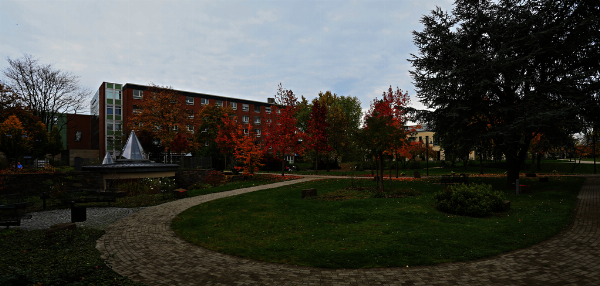
Dießemer Bruch 81
47805 Krefeld
Phone:
02151-334-3551
Mail:
ed.dleferk-renaixela@ofni
ed.dleferk-renaixela@ofni
ed.dleferk-renaixela@ofni
- Number of beds: 628
- Number of specialist departments: 10
- Number of inpatient cases: 16.943
- Number of partial inpatient cases: 332
- Number of outpatient cases: 32.203
- Hospital owners: Alexianer Krefeld GmbH
- Type of provider: freigemeinnützig
- Academic teaching hospital
- Heinrich-Heine-Universität Düsseldorf
- Klinik für Kardiologie, Pneumologie und Innere Medizin
- Psychiatrische Tageskliniken mit allgemeinpsychiatrische, gerontopsychiatrischen und psychotraumatologischen Schwerpunkten
- Klinik für Gastroenterologie und Onkologie
- Klinik für Geriatrie
- Klinik für Allgemein-, Viszeral-, endokrine und Gefäßchirurgie
- Klinik für Unfallchirurgie, Orthopädie, Hand- und Wiederherstellungschirurgie
- Klinik für Urologie, Kinderurologie, Urogynäkologie und Andrologie
- Klinik für Neurologie
- Klinik für Notfallmedizin
- Klinik für Psychische Gesundheit
Further information
- External quality assurance according to state law
No participation
- Quality of participation in the Disease Management Programme (DMP)
No participation
| Quantity performed | 50 |
| Exception? | No exception |
| Quantity performed | 7 |
| Exception? | No exception |
| Overall result forecast presentation: | yes |
| Quantity performed reporting year: | 50 |
| Quantity forecast year: | 50 |
| Examination by state associations? | yes |
| Exemption? | yes |
| Result of the examination by the federal state authorities? | yes |
| Transitional arrangement? | no |
| Overall result forecast presentation: | no |
| Quantity performed reporting year: | 7 |
| Quantity forecast year: | 4 |
| Examination by state associations? | no |
| Exemption? | no |
| Result of the examination by the federal state authorities? | no |
| Transitional arrangement? | no |
- Implementation of resolutions of the Federal Joint Committee on quality assurance (G-BA)
No participation
- Clarifying chat completed: no
- Clarifying chat not completed: no
- No participation in clarifying chat: no
- Notification of non-fulfilment of nursing care not made: no
quarter Q1
Erwachsenenpsychiatrie
| Day shift | ||
|---|---|---|
| Compliance with minimum requirements | no | |
| Level of implementation | 93,0 % | |
| Occupational group | Minimum requirements met | Level of implementation (%) |
| Ärztinnen und Ärzte, ärztliche Psychotherapeutinnen und Psychotherapeuten | ja | 123,9 % |
| Pflegefachpersonen | nein | 80,89 % |
| Psychotherapeutinnen und Psychotherapeuten (ohne ärztliche Psychotherapeutinnen und Psychotherapeuten), Psychologinnen und Psychologen | ja | 182,93 % |
| Spezialtherapeutinnen und Spezialtherapeuten | nein | 80,08 % |
| Bewegungstherapeutinnen und Bewegungstherapeuten, Physiotherapeutinnen und Physiotherapeuten | ja | 129,59 % |
| Sozialarbeiterinnen und Sozialarbeiter, Sozialpädagoginnen und Sozialpädagogen, Heilpädagoginnen und Heilpädagogen | ja | 116,27 % |
| Night shift | ||
| Compliance with minimum requirements | no | |
| Minimum requirement (full-time staff) | 156 | |
| Current staffing levels (full-time staff) | 137 | |
| Number of nights, subject to the minimum requirement | 2 | |
quarter Q2
Erwachsenenpsychiatrie
| Day shift | ||
|---|---|---|
| Compliance with minimum requirements | no | |
| Level of implementation | 95,0 % | |
| Occupational group | Minimum requirements met | Level of implementation (%) |
| Ärztinnen und Ärzte, ärztliche Psychotherapeutinnen und Psychotherapeuten | ja | 143,49 % |
| Pflegefachpersonen | nein | 86,38 % |
| Psychotherapeutinnen und Psychotherapeuten (ohne ärztliche Psychotherapeutinnen und Psychotherapeuten), Psychologinnen und Psychologen | ja | 163,67 % |
| Spezialtherapeutinnen und Spezialtherapeuten | nein | 65,46 % |
| Bewegungstherapeutinnen und Bewegungstherapeuten, Physiotherapeutinnen und Physiotherapeuten | ja | 105,58 % |
| Sozialarbeiterinnen und Sozialarbeiter, Sozialpädagoginnen und Sozialpädagogen, Heilpädagoginnen und Heilpädagogen | nein | 73,95 % |
| Night shift | ||
| Compliance with minimum requirements | no | |
| Minimum requirement (full-time staff) | 156 | |
| Current staffing levels (full-time staff) | 114 | |
| Number of nights, subject to the minimum requirement | 0 | |
quarter Q3
Erwachsenenpsychiatrie
| Day shift | ||
|---|---|---|
| Compliance with minimum requirements | no | |
| Level of implementation | 97,0 % | |
| Occupational group | Minimum requirements met | Level of implementation (%) |
| Ärztinnen und Ärzte, ärztliche Psychotherapeutinnen und Psychotherapeuten | ja | 135,09 % |
| Pflegefachpersonen | ja | 90,84 % |
| Psychotherapeutinnen und Psychotherapeuten (ohne ärztliche Psychotherapeutinnen und Psychotherapeuten), Psychologinnen und Psychologen | ja | 161,6 % |
| Spezialtherapeutinnen und Spezialtherapeuten | nein | 55,11 % |
| Bewegungstherapeutinnen und Bewegungstherapeuten, Physiotherapeutinnen und Physiotherapeuten | ja | 110,17 % |
| Sozialarbeiterinnen und Sozialarbeiter, Sozialpädagoginnen und Sozialpädagogen, Heilpädagoginnen und Heilpädagogen | ja | 92,36 % |
| Night shift | ||
| Compliance with minimum requirements | no | |
| Minimum requirement (full-time staff) | 156 | |
| Current staffing levels (full-time staff) | 134 | |
| Number of nights, subject to the minimum requirement | 0 | |
quarter Q4
Erwachsenenpsychiatrie
| Day shift | ||
|---|---|---|
| Compliance with minimum requirements | no | |
| Level of implementation | 98,0 % | |
| Occupational group | Minimum requirements met | Level of implementation (%) |
| Ärztinnen und Ärzte, ärztliche Psychotherapeutinnen und Psychotherapeuten | ja | 130,2 % |
| Pflegefachpersonen | ja | 91,61 % |
| Psychotherapeutinnen und Psychotherapeuten (ohne ärztliche Psychotherapeutinnen und Psychotherapeuten), Psychologinnen und Psychologen | ja | 154,57 % |
| Spezialtherapeutinnen und Spezialtherapeuten | nein | 67,17 % |
| Bewegungstherapeutinnen und Bewegungstherapeuten, Physiotherapeutinnen und Physiotherapeuten | ja | 95,73 % |
| Sozialarbeiterinnen und Sozialarbeiter, Sozialpädagoginnen und Sozialpädagogen, Heilpädagoginnen und Heilpädagogen | ja | 100,49 % |
| Night shift | ||
| Compliance with minimum requirements | no | |
| Minimum requirement (full-time staff) | 156 | |
| Current staffing levels (full-time staff) | 125 | |
| Number of nights, subject to the minimum requirement | 0 | |
| Number | Group |
|---|---|
| 153 | Medical specialists (m/f) , psychological psychotherapists (m/f) and child and adolescent psychotherapists (m/f) who are subject to the obligation to undergo further training* |
| 127 | Number of medical specialists (m/f) from no. 1 who have completed a five-year period of further training and are therefore subject to the obligation to provide evidence |
| 101 | Number of those persons from no. 2 who have provided proof of further training according to Article 3 of the G-BA regulations |
According to Section 4 (2) of the Quality Management Guideline, facilities must provide for the prevention of and intervention in cases of violence and abuse as part of their internal quality management. The aim is to prevent, recognise and respond appropriately to abuse and violence, particularly against vulnerable patient groups such as children and adolescents or people in need of help, and also to prevent it within the facility. The respective procedure is aligned with the size of the facility, the range of services and the patients in order to define customised solutions for sensitising the teams as well as other suitable preventative and interventional measures. These may include information materials, contact addresses, training/education, codes of conduct, recommendations for action/intervention plans or comprehensive protection concepts.
- Is a protection concept in place? Yes
- Measures
-
Prevention
- Note on the measure
weitreichende Informationen für Mitarbeitende über die Seite Prävention und Intervention der Alexianer GmbH und der Alexianer Krefeld.
- Note on the measure
Verpflichtende Fortbildung für alle Mitarbeitenden "Basisprävention sexualisierte Gewalt"
- Note on the measure
-
Intervention
- Last review of the measure
01.09.2022 21:13:36
- Last review of the measure
-
Review
- Last review of the measure
01.09.2022 21:13:36
- Last review of the measure
-
Prevention
- weitreichende Informationen für Mitarbeitende über die Seite Prävention und Intervention der Alexianer GmbH und der Alexianer Krefeld.
- Drug commission
Training of employees on AMTS related topics
Availability of appropriate, topic-specific informational materials for patients on AMTS e.g. for chronic diseases, for high-risk drugs, for children
sämtliche Verfahrensregelungen sind im elektronischen Handbuch (im Dokumentenlenkungssystem) für alle Mitarbeiter in der aktuellen Version jederzeit verfügbar.
10.10.2025
Electronic support for the admission and anamnesis process (e.g. import of patient master data or medication plans, use of a drug knowledge database, input screen for drugs or anamnesis information)
Richten und Verabreichen von Arzneitmittel
18.04.2023
ORME Anleitungen
14.03.2025
Possibility of electronic prescription i.e. structured entry of active substances (or name of the preparation), form, dose, dose frequency (e.g. in the HIS, in prescription software)
Provision of one or more electronic drug information systems (e.g. Lauer-Taxe®, ifap klinikCenter®, Gelbe Liste®, Fachinfo-Service®)
- Bereitstellung einer geeigneten Infrastruktur zur Sicherstellung einer fehlerfreien Zubereitung
- Anwendung von gebrauchsfertigen Arzneimitteln bzw. Zubereitungen
Electronic documentation of the administration of drugs
- Fallbesprechungen
- Maßnahmen zur Vermeidung von Arzneimittelverwechslung
- Spezielle AMTS-Visiten (z. B. pharmazeutische Visiten, antibiotic stewardship, Ernährung)
- Aushändigung von Patienteninformationen zur Umsetzung von Therapieempfehlungen
- Aushändigung des Medikationsplans
- bei Bedarf Arzneimittel-Mitgabe oder Ausstellung von Entlassrezepten
- Admission to hospital, including anamnesis
; Instruments and measures are presented for determining the old medication (drug history), the subsequent clinical assessment and the switch to the medication available in the hospital (house list), as well as for documenting both the patient's original medication and that for hospital treatment adapted medication.
- Medication process in the hospital
In this context, the following sub-processes are assumed as examples: drug history - prescription - patient information - drug delivery - drug use - documentation - therapy monitoring - result assessment. Instruments and measures for safe medication prescription can be presented, e.g. B. in terms of readability, clarity and completeness of the documentation, but also in terms of area of application, effectiveness, benefit-risk ratio, tolerability (including potential contraindications, interactions, etc.) and resource considerations. Information can also be provided to support reliable medication ordering, delivery and use or administration.
- Discharge
In particular, the measures taken by hospitals can be presented to ensure that information on drug therapy is structured and passed on to doctors and physicians providing further treatment, as well as the appropriate provision of patients with drug information, medication plans and medications. Drug prescriptions are made.
Job
Explanation
z.B. in der Chirurgie Dozenten aus Marburg oder Düsseldorf z.B. Lehrauftrag in der Universität Köln im Bereich Rehawesen
Explanation
Z.B. in der Chirurgie Dozenten aus Kaiserswerther Diakonie Z.B. Lehraufträge Ärztekammer Nordrhein und Westfalen-Lippe
Explanation
z.B. Famulatur von Medizinstudenten, Praktisches Jahr im Rahmen des Lehrkrankenhauses, Praktika von Physician Assistant
Explanation
z.B. in der Chirurgie mit der Universität Tübingen, Wien, Sorbonne Paris im Rahmen von OP Kursen und wissenschaftlichen Projekten (EUROCRINE)
FL09 - Doctoral supervision
Explanation
FL06 - Participation in multi-centre phase III/IV studies
Explanation
Explanation
Publikationen in Pubmed gelisteten wissenschaftlichen Zeitschriften/ Journals. Buchbeiträge in chirurgischen Fachbüchern. Medikamentöse Suchttherapie erschienen im Kohlhammer Verlag Sep. 2022
FL05 - Participation in multi-centre Phase I/II studies
Explanation
Training in other healing professions
Comment
Ausbildung: Akupunktur nach dem NADA-Protokoll
Comment
In Kooperation mit der Kaiserswerther Diakonie Düsseldorf
HB17 - Auxiliary nurse (m/f)
Comment
Comment
In Kooperation mit der Kaiserswerther Diakonie Düsseldorf
HB03 - Physical therapist / physiotherapist (m/f)
Comment
Comment
In Kooperation mit den Maltesern Aachen
HB19 - Nursing professionals
Comment
HB21 - Geriatric nurse (m/f)
Comment
HB20 - Nursing professional B. Sc.
Comment
Comment
Med. Fachangestellte
HB06 - Occupational therapist (m/f)
Comment
- Hospital staff
- Number of pharmacists: 5
- Additional staff: 2
- Explanations: Weiteres Apothekenpersonal: 2 PKA (davon 1x mit SGB 50) Weiteres pharmazeutisches Personal: 1 PTA und 1 Pharmazeut:in im Praktikum
Frau Gabriela Andriessen
Patientenfürsprecher
Dießemer Bruch 81
47805 Krefeld
Phone:
02151
-334-3360
Mail:
ed.renaixela@nesseirdna.g
Frau Marita Schneider
Sekretariat der Geschäftsführung
Dießemer Bruch 81
47805 Krefeld
Phone:
02151
-334-3551
Mail:
ed.renaixela@redienhcs.atiram
Frau Jessica Anders
Leitung Qualitätsmanagement
Dießemer Bruch 81
47805 Krefeld
Phone:
02151
-334-3897
Mail:
ed.renaixela@sredna.j
Herr Tim Heller
Leiter Krankenhausapotheke
Dießemer Bruch 81
47805 Krefeld
Phone:
02151
-334-3905
Mail:
ed.renaixela@relleh.t
Frau Karin Balters
Chefarztsekretariat Klinik für Psychische Gesundheit
Dießemer Bruch 81
47805 Krefeld
Phone:
02151
-334-7140
Mail:
ed.renaixela@sretlaB.K
47805 Krefeld
Phone:
02151-334-3551
Mail:
ed.dleferk-renaixela@ofni
Frau Nicole Hilbert-Kluczkowski
Pflegedirektorin
Dießemer Bruch 81
47805 Krefeld
Phone:
02151
-334-7451
Mail:
ed.renaixela@snameseoH.t
Herr Norman Westphal
Geschäftsführer
Dießemer Bruch 81
47805 Krefeld
Phone:
02151
-334-3551
Mail:
ed.dleferk-renaixela@ofni
Herr Norman Westphal
Geschäftsführer
Dießemer Bruch 81
47805 Krefeld
Phone:
02151
-334-3551
Mail:
ed.renaixela@redienhcs.m
Prof. Dr. med. Hans-Jürgen von Giesen
Ärztlicher Direktor, Chefarzt der Klinik für Neurologie
Dießemer Bruch 81
47805 Krefeld
Phone:
02151
-334-7156
Mail:
ed.renaixela@netsiel.N
IK: 260510611
Location number: 771123000